
BREAKING THE CODE
A research-focused VR narrative experience exploring discrimination, exclusion, and accessibility within IT education spaces through immersive interaction, environmental storytelling, and emotional design.
PROJECT_OVERVIEW
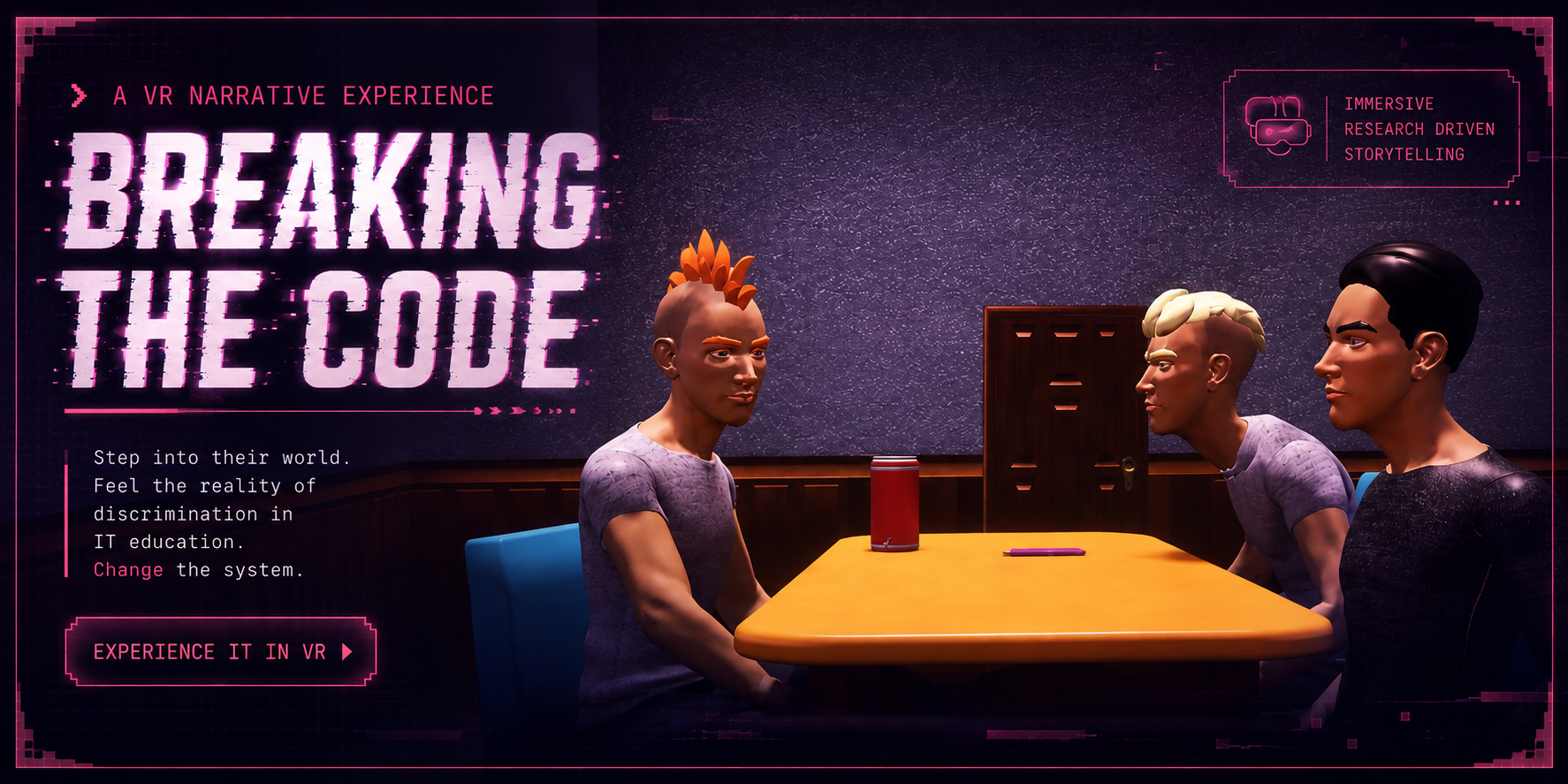
Breaking the Code was developed as a research-driven immersive VR experience investigating discrimination and exclusion within educational technology spaces.
The project explored how virtual reality and environmental storytelling could be used to increase empathy, awareness, and emotional engagement when discussing sensitive social issues.
Rather than presenting information traditionally, players experience isolation, discomfort, and tension directly through interaction and atmosphere.
RESEARCH_QUESTION
The research explored how immersive VR storytelling can improve awareness and understanding of discrimination in IT education by placing users inside emotionally engaging scenarios. Through player embodiment, environmental interaction, and spatial storytelling, the project aimed to create stronger empathy, emotional impact, and perspective-taking compared to traditional educational media such as videos or written case studies.
DEVELOPMENT
Built in Unreal Engine using Blueprint systems, the project focused heavily on immersion, pacing, emotional framing, and interaction design.
GAMEPLAY_FOOTAGE
RESEARCH + METHODOLOGY
The project combined practical VR development with research into discrimination and female experiences within IT and STEM education environments at USW. Research findings highlighted that many participants reported experiencing some form of gender-based discrimination during their studies, helping to inform the emotional themes, environmental storytelling, and interaction design used throughout the VR experience.
The experience was designed to explore the emotional impact of social exclusion, environmental discomfort, and the bystander effect within educational spaces. Through immersive first-person storytelling, the project aimed to encourage player reflection on how silence, lack of intervention, and everyday behaviour can contribute to discriminatory experiences.
RESEARCH FINDINGS
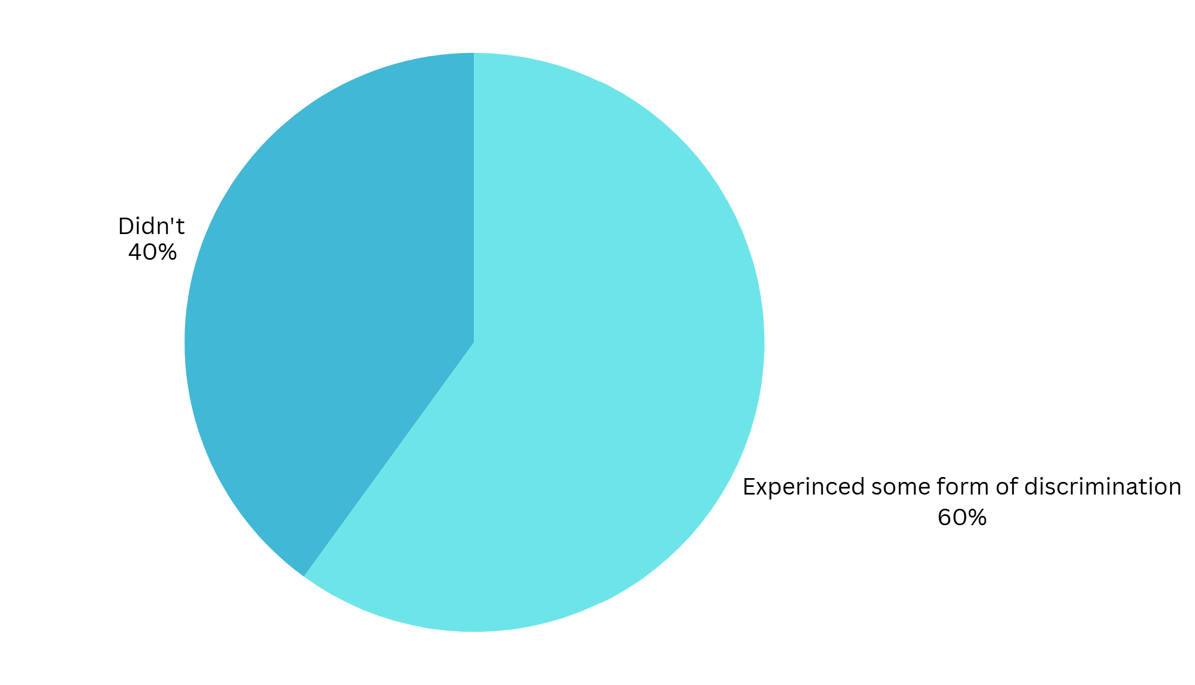
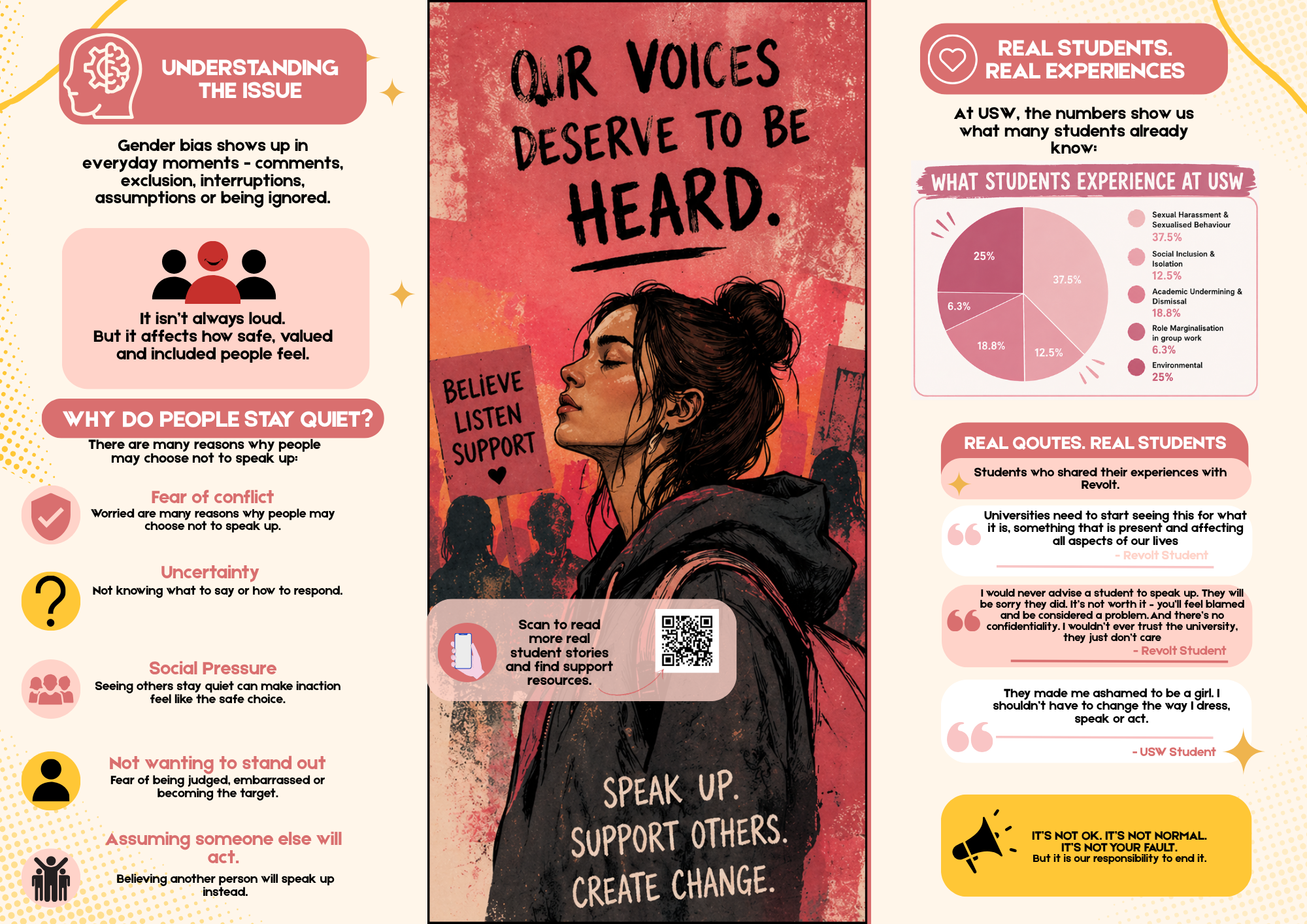
Research data collected from participants at USW showed that 60% reported experiencing some form of gender-based discrimination within educational environments, while 40% reported no personal experience of discrimination.
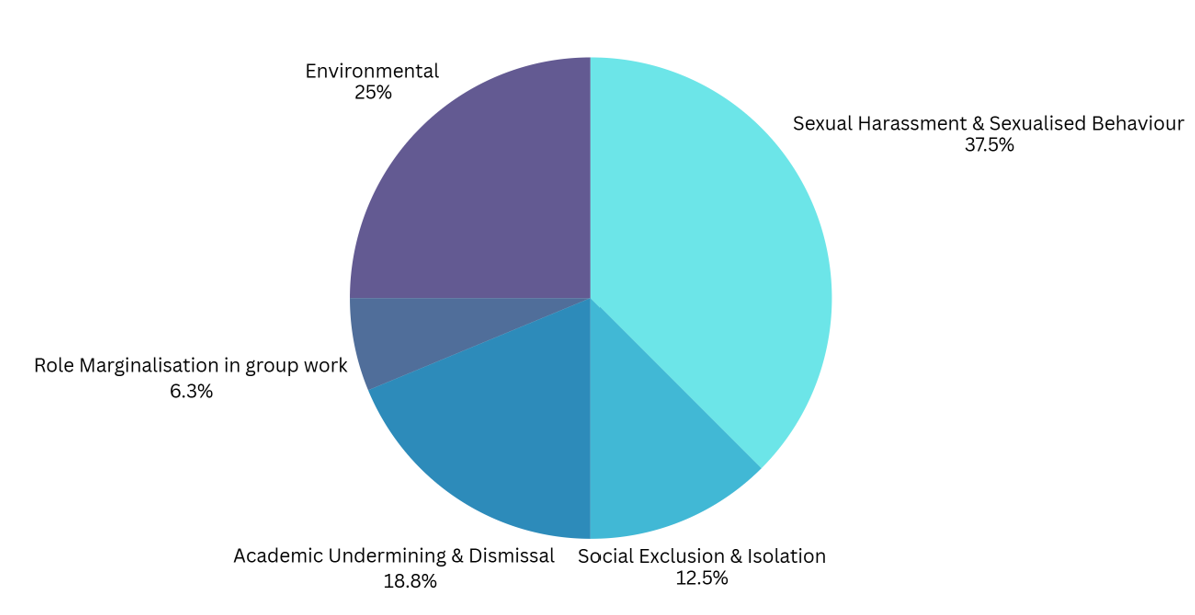
Participants also identified several common forms of discrimination and exclusion experienced within IT and STEM spaces. The most commonly reported issue involved sexual harassment and sexualised behaviour, followed by environmental discomfort, academic undermining, and social exclusion.
PRESENTATION + SHOWCASE
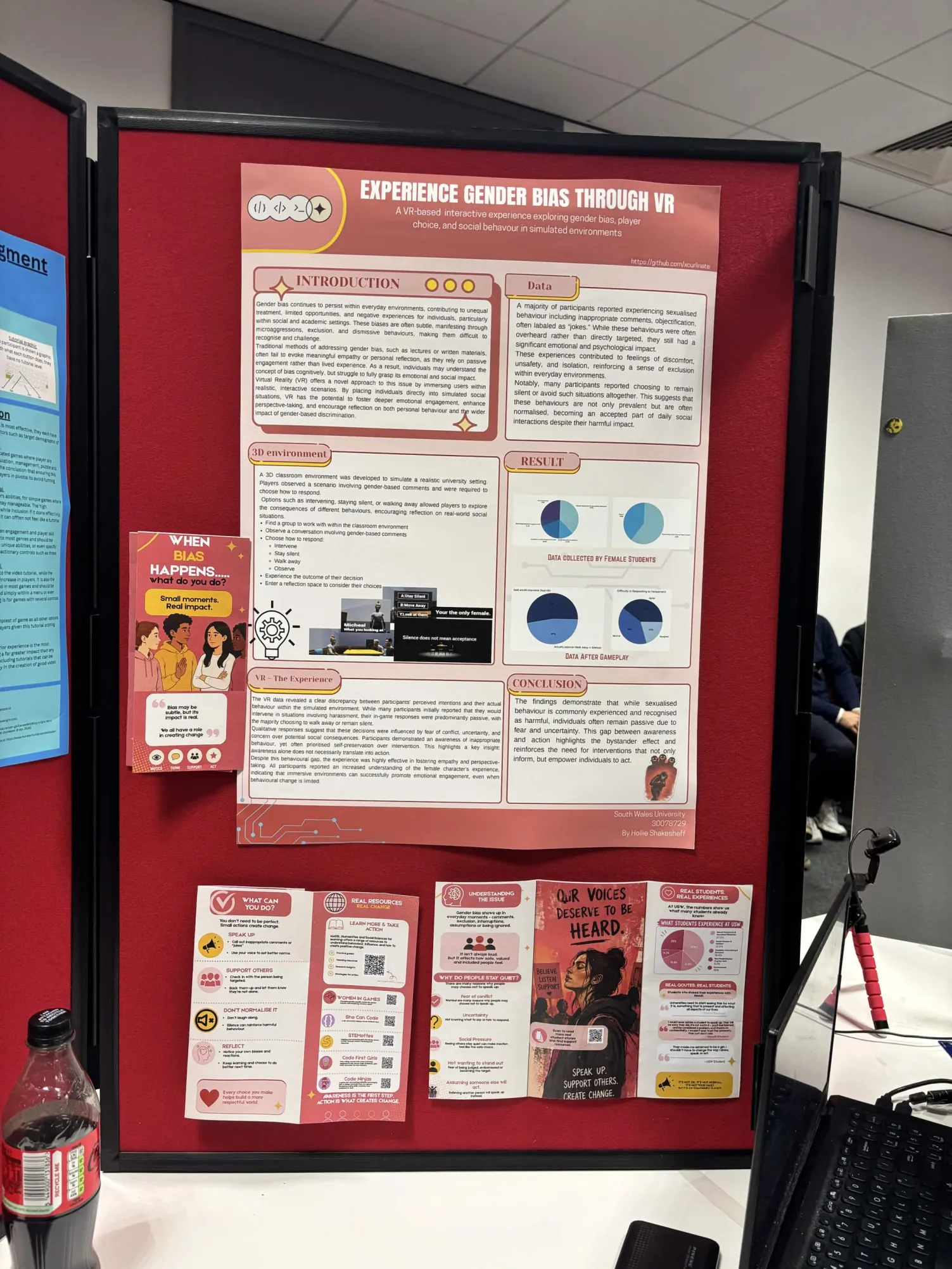
The final project presentation combined research findings, VR development documentation, and audience engagement materials to communicate both the technical and social aims of the project. Due to space limitations and VR wire management considerations, a recorded gameplay video of the VR experience was showcased during the presentation instead of a live playable demonstration.
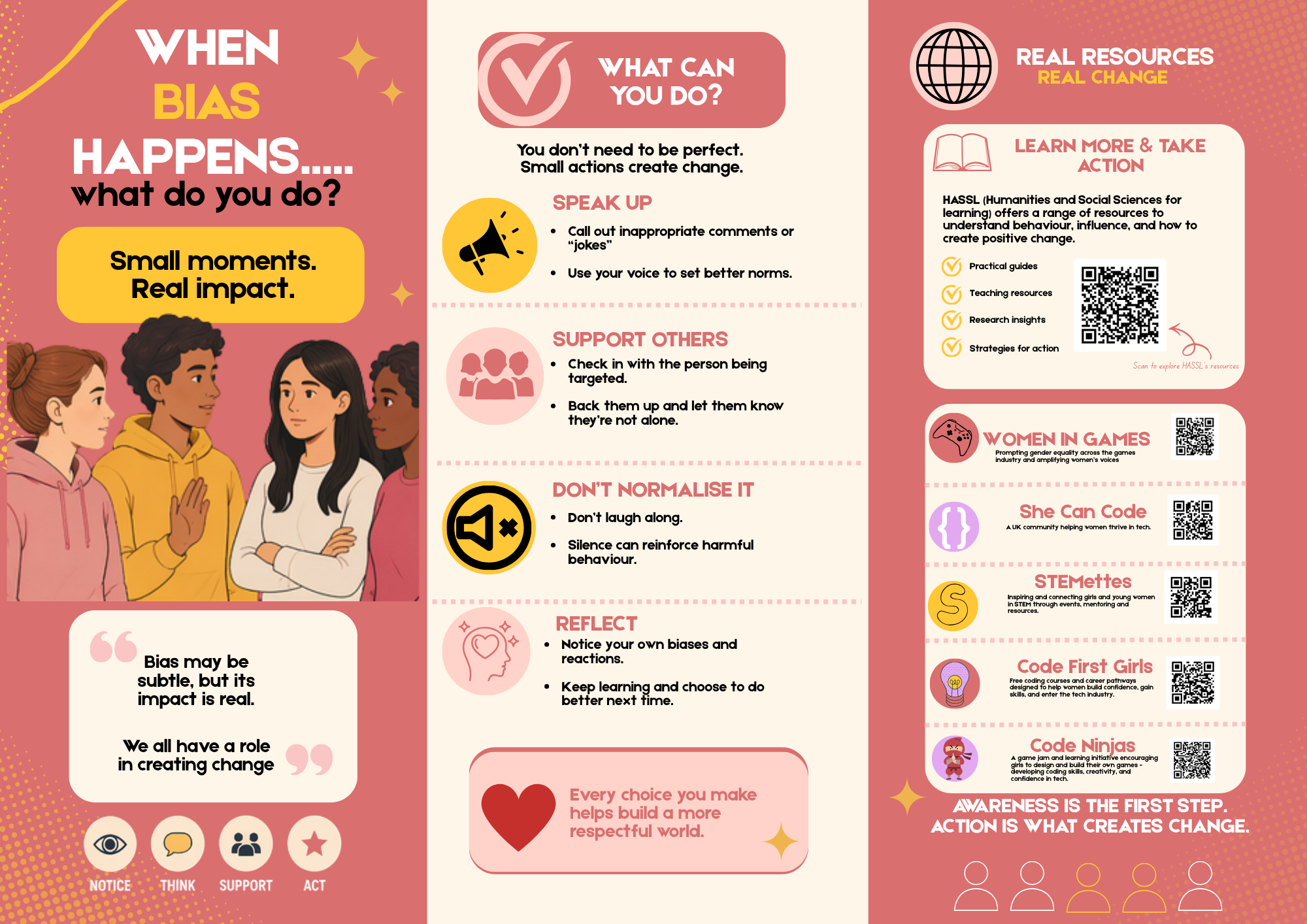
Alongside the presentation, informational leaflets were designed and distributed to visitors viewing the project. These materials included statistics gathered from USW research participants, information about discrimination within educational environments, explanations of the bystander effect, and resources aimed at supporting women within STEM and IT education.
The leaflets also provided links to support groups, free educational resources, and suggestions for how educational communities can improve inclusivity, encourage intervention, and create safer environments for discussion and participation.
LEAFLETS & POSTERS
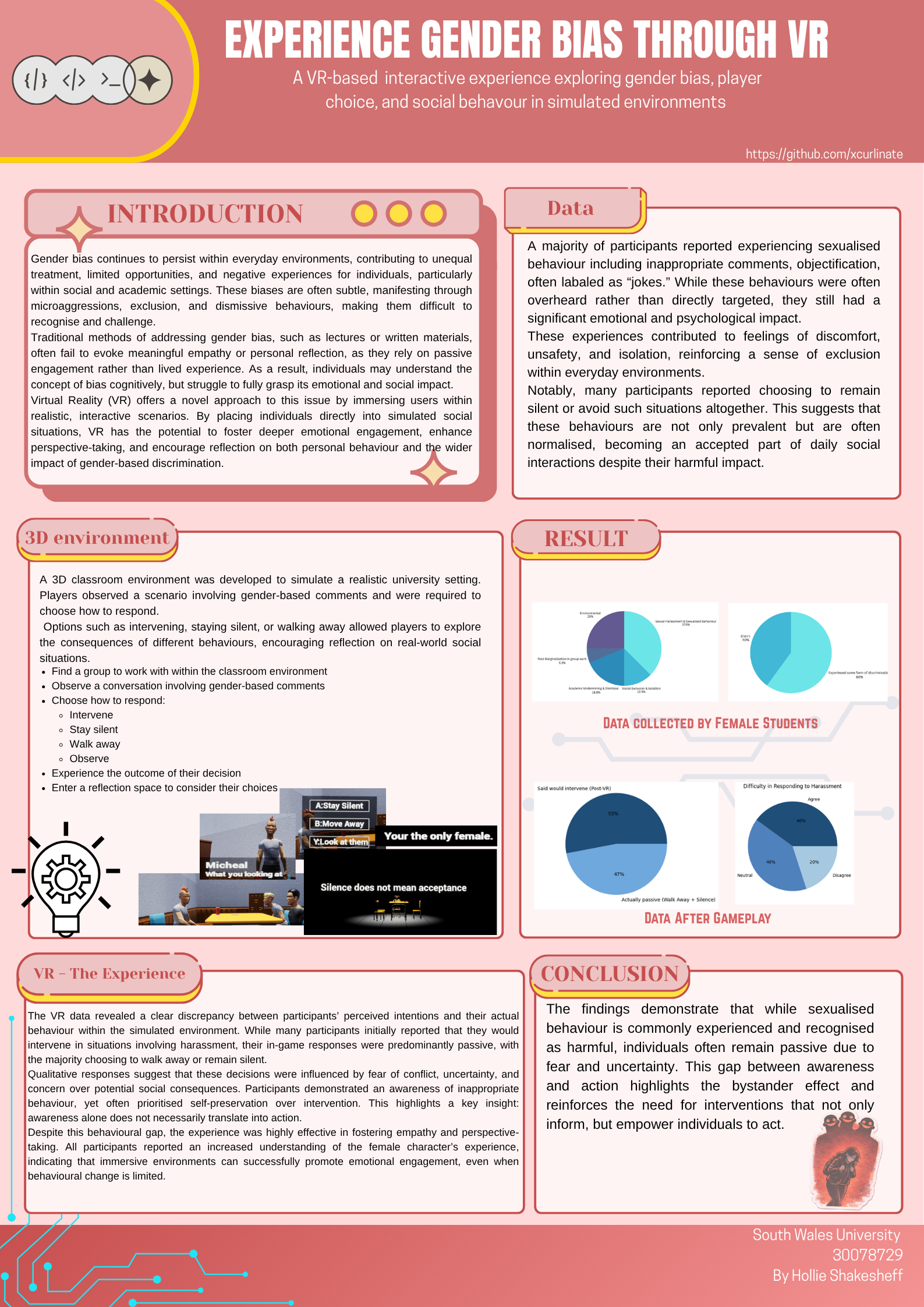
Promotional and educational materials were created to support the final project presentation. These materials highlighted research findings from USW participants, explained the bystander effect, and provided information about improving inclusivity within STEM and IT education environments.
The poster focused on both the research data and the VR development process, while the leaflets provided visitors with accessible statistics, support resources, and further information about discrimination awareness and educational support networks.
DEVELOPMENT_TIMELINE
PRE-PRODUCTION
Research into discrimination within IT education, narrative planning, and environmental concept work.
RESEARCH + PRE-PRODUCTION
Investigating discrimination within IT education, analysing immersive storytelling techniques, and planning how VR interaction systems could support emotional engagement, empathy, and player perspective-taking.
VR PROTOTYPING + DEVELOPMENT
Developing the experience in Unreal Engine through VR interaction prototyping, environmental storytelling, spatial audio implementation, lighting design, and narrative pacing focused on emotional immersion and player comfort.
TESTING + EVALUATION
Conducting user testing sessions, gathering participant feedback, and evaluating emotional impact, accessibility, motion sickness, narrative clarity, and awareness of discrimination themes within the experience.
FINDINGS
User feedback suggested that immersive VR storytelling created stronger emotional engagement, awareness, and perspective-taking compared to more traditional educational formats such as written scenarios or video-based learning. Participants reported that experiencing situations from a first-person perspective increased the emotional impact of the narrative and encouraged reflection on discrimination within IT education environments.
Players responded particularly strongly to:
CHALLENGES
One of the main challenges during development was balancing emotional storytelling with player comfort in VR spaces. During user testing, several participants who were unfamiliar with VR or gaming experienced motion sickness and discomfort, which required careful consideration of movement systems, pacing, environmental readability, and accessibility features to reduce player fatigue and avoid overwhelming users.
Another challenge involved participant recruitment for the research study. As the project focused on discrimination and female representation within IT education, it was initially difficult to encourage male participants to take part, with some stating that the experience was “not for them.” Despite this, the project successfully gathered feedback from around ten participants, providing valuable insights for evaluation and future improvements.
The development process was also impacted by personal health challenges during production. Periods of severe migraines and illness made extended VR headset usage difficult, which affected development workflow and testing sessions. This required careful time management, adaptation of work practices, and balancing both technical development and personal wellbeing throughout the project.
REFLECTION
This project strengthened my understanding of VR development within Unreal Engine, particularly as my primary development background is in Unity. Through the creation of the experience, I further developed my skills in immersive design, emotional interaction systems, narrative pacing, and research-led development. The project also challenged my ability to design interactive experiences that balance technical implementation with meaningful social themes and player engagement.
The research deepened my interest in serious games, educational experiences, and the use of gameplay systems to encourage social discussion and awareness. Moving forward, I aim to continue collaborating with USW to further develop and potentially implement the experience as part of initiatives focused on encouraging more female participation within STEM and IT-related education environments.
FUTURE_IMPROVEMENTS
Future development could explore alternative non-VR versions of the experience to improve accessibility for users unfamiliar with virtual reality technology. During testing, some participants experienced motion sickness or discomfort, particularly those with limited gaming or VR experience. While the research showed that VR storytelling can effectively increase awareness and emotional engagement, a desktop or non-VR adaptation could provide a more accessible way for wider audiences to experience the narrative without physical discomfort. Future work could also expand player interaction, accessibility settings, branching narratives, and larger-scale user testing.
PERSONAL_INSPIRATION
Games have always meant more to me than just entertainment. Growing up surrounded by video games, I often found comfort and escape within them, especially as I got older and responsibilities began building around me. Games became a space where I could disconnect from stress and reconnect with creativity, imagination, and something that genuinely made me happy.
Before studying game development, I originally pursued computer forensics and cybersecurity-related studies. While learning about network packets, digital investigations, and technical systems, I spent most of my spare time experimenting with game development on the side. Even then, I realised I was far more excited by creating experiences, mechanics, and stories than the career path I was originally following. Eventually, I made the decision to leave that path behind and pursue the thing that had always made me happiest — game development.
I did not go into game development simply because I loved playing games. I went into it because I loved creating them. There was something incredibly satisfying about starting from nothing and slowly building an interactive experience from the ground up. More than anything, I hoped to find a creative community of people who shared that same passion and excitement for making games.
When I started at USW, I entered with that hope. I expected a welcoming creative environment where people supported one another through shared interests and creativity. Instead, over time, my experience within game development and STEM-related educational spaces became one of exclusion, hostility, rumours, harassment, sexualisation, fake accounts, and ongoing social isolation that significantly affected both my confidence and wellbeing.
False rumours spread throughout social groups and classroom environments, and situations escalated to the point where I was accused of inappropriate behaviour, excluded from community spaces, and made to feel unwelcome within an environment I originally hoped would become my community. Attempts to defend myself or clear my name often felt pointless, as once rumours spread, people appeared more willing to follow the crowd than question what was actually true. At times, it felt less like a university environment and more like being trapped inside a social hierarchy where one accusation or rumour could completely shape how others treated you.
Some experiences became particularly distressing, including threats of violence, harassment connected to relationships, false accusations, and situations where I felt completely isolated socially despite trying repeatedly to fit in and contribute positively. No matter how much effort I made to be accepted, it often felt as though I had already been judged before people truly knew me.
These experiences became the foundation of Breaking the Code.
Initially, I wanted to understand why women within STEM and game development spaces often experience discrimination, exclusion, or hostility. However, during the research process itself, I began learning about concepts such as the bystander effect and how social behaviour within groups can influence whether people choose to intervene during harmful situations. Through my research, I became increasingly interested in how fear of social consequences, group mentality, uncertainty, or self-preservation can cause people to remain silent even when they recognise behaviour as harmful or unfair.
This research strongly influenced the direction of the project.
Through immersive VR storytelling, Breaking the Code explores these themes by placing players directly into uncomfortable social situations inspired by real emotional experiences. Rather than simply presenting information through text or discussion, the project aims to create empathy, reflection, emotional discomfort, and awareness through interaction, atmosphere, environmental storytelling, and perspective-taking.
At the same time, despite these experiences, I was also supported by several incredible lecturers and staff members within USW who encouraged me to continue progressing academically and creatively. Alongside developing this dissertation, I was encouraged to explore opportunities surrounding teaching, interactive learning, serious games, and educational design. This support helped guide me towards pursuing my teaching degree, applying for Advance HE Fellowship recognition, and continuing to explore how interactive experiences and serious games can be used to support education, awareness, empathy, and social discussion.
Ultimately, Breaking the Code became more than a VR experience. It became both a personal and research-driven exploration into discrimination, social behaviour, empathy, exclusion, and the importance of creating supportive communities within STEM and educational spaces.